
Festive Sale Customer Support Checklist for Indian D2C Brands (Diwali 2026)

Executive Summary
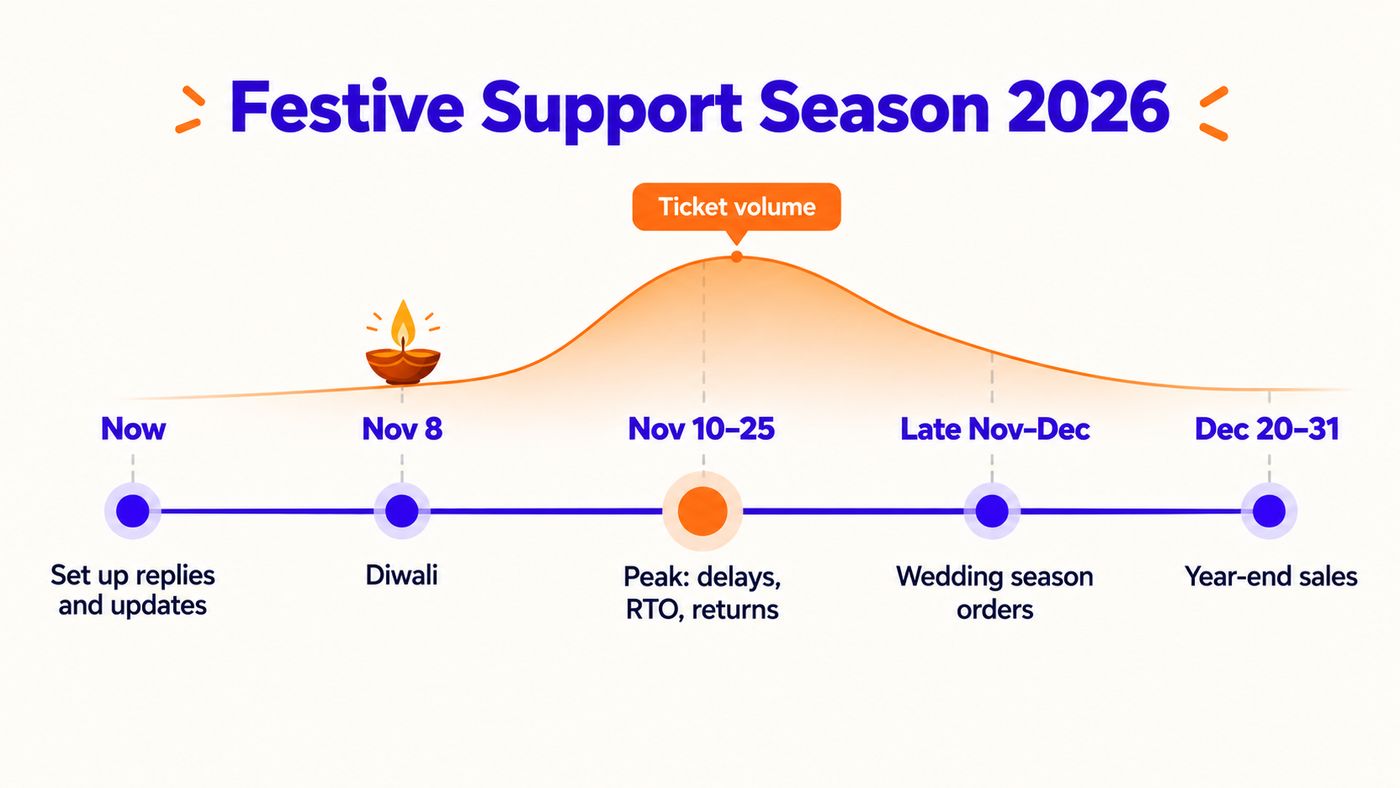
- Diwali 2026 falls on November 8. For most Indian D2C brands, the heaviest support load comes after it, from mid-November to mid-December, so the time to prepare is now.
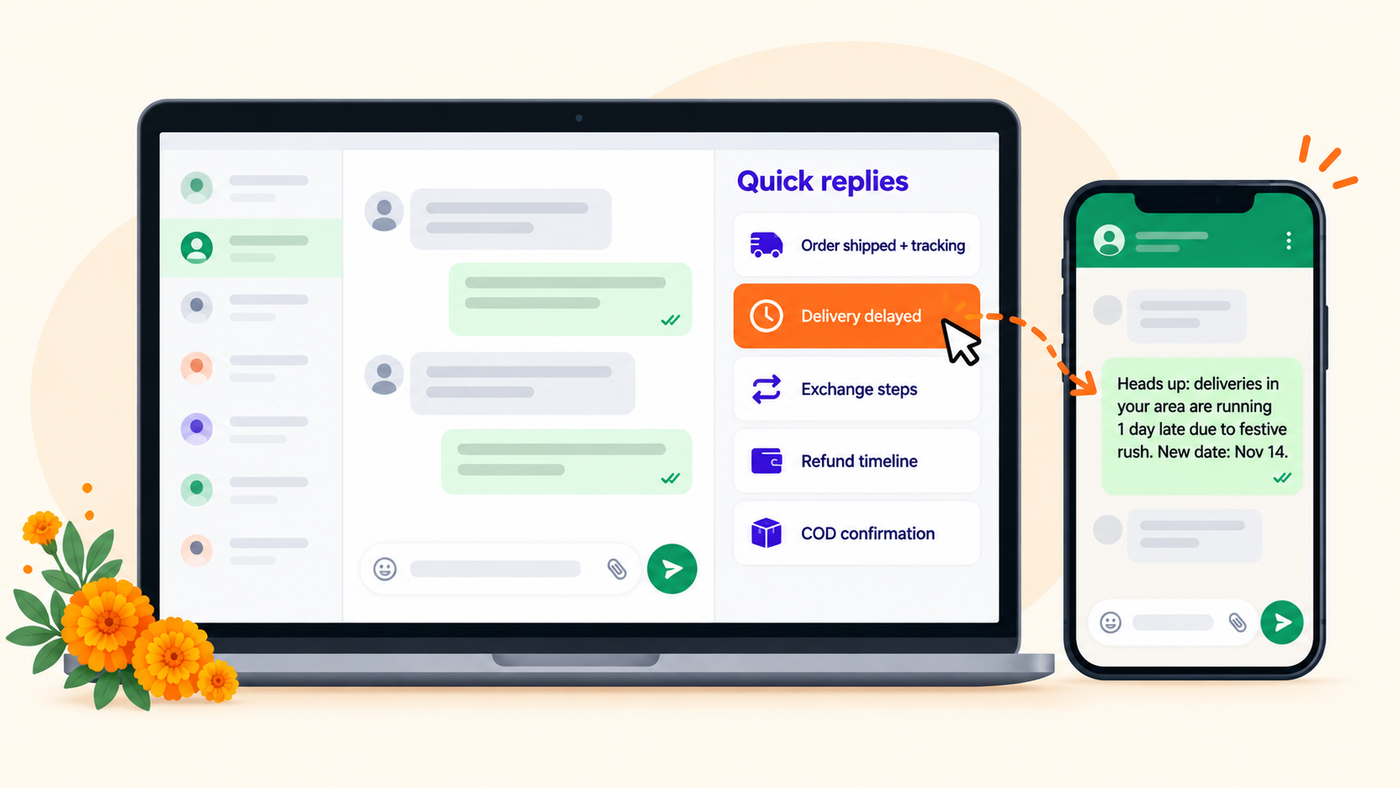
- Set up tags, saved replies and proactive WhatsApp and SMS updates before the sale, so “order kab aayega” messages stay under control.
- Plan for failed deliveries and COD returns, make exchanges easier than refunds, and keep refund timelines clear for UPI, card and COD orders.
- Make sure complaints are acknowledged within 48 hours, as India’s Consumer Protection (E-Commerce) Rules expect, and plan staffing through wedding season and year-end sales.
Every year it’s the same story. The Diwali sale wraps up, the sales numbers look fantastic, the team grabs some mithai and finally breathes. And then, give it two days, the messages start piling in.
“Order kab aayega?” “Delivery wala aaya hi nahi, but tracking pe attempted dikha raha hai.” “Size chhota hai, exchange chahiye.” “Refund ka kya hua?” “COD wala order cancel karna hai.” Now multiply that by a few thousand orders. Suddenly your support team’s working harder than they did in the sale itself.
We’ve watched this happen with Indian D2C brands again and again. The sale’s honestly the easy part. It’s the three or four weeks after it where your D2C customers make up their minds about whether they’ll ever buy from you again.
Good news, though. Diwali’s still a little over a week away, so there’s time. Here’s the festive sale customer support checklist we run through with our own clients before the rush. Nothing fancy. Just the bits that actually make a difference.
Why the Festive Sales Season Gets Harder After Diwali
This year, Diwali falls on Sunday, November 8. Most festive sales peak two or three weeks before that, so a big chunk of orders end up stuck with couriers right around the festival. Couriers are stretched thin, and half the country’s on a train or a flight back home.
That’s why support gets busiest after the sale, not during it. Parcels show up late. Deliveries fail because nobody’s at home. COD orders get turned away at the door and come back as RTO. Gifts need swapping. Refund questions keep coming. And right when it starts to calm down, wedding season and year-end sales kick off.
Whatever happens in these few weeks shows up later, in your reviews, your repeat orders, and how many people come back for your next sale.
1. Clear the Backlog First
Before anything else, get the inbox in order. We really mean it. Start here.
Tag every open ticket by what it’s about: order status, delivery issue, return or exchange, refund, cancellation, product question, complaint. Most helpdesks can do this automatically once you set a few rules. Then sort by urgency. Address changes on undelivered orders, wrong or damaged products and properly upset customers go first. The simple “where is it” questions can be cleared in a batch.
If you don’t have tags and saved replies set up yet, do it this week, while it’s still quiet. You can borrow templates from our post on customer service macros, and our guide to customer service automation shows how to set up the rules.
2. Get Ahead of “Order Kab Aayega?”
This is the big one. It’ll probably be more of your tickets than anything else, so don’t sit and wait for it.
Send updates on WhatsApp and SMS, not only email. Most people in India check WhatsApp within minutes. Email? It can sit there for days. Share the tracking link when the order ships, a quick message when it’s out for delivery, and a heads-up the moment anything’s running late. If you know one courier’s slow in certain pin codes, message those customers before they message you.
Also, open your tracking page on an actual phone and look at it like a customer would. It should say what’s happening in simple words, not some courier code nobody can make sense of. We go into this more in our guide to reducing WISMO tickets.
3. Tackle Failed Deliveries and RTO Quickly
Failed deliveries and RTOs are painful in India, and COD makes it worse. Every parcel that comes back unopened means you’ve paid for shipping twice, and that stock’s out of action for days.
Make it a habit to open your NDR (non-delivery report) list every morning, whether that’s in Shiprocket, Delhivery or something else. For every failed attempt, drop the customer a WhatsApp message the same day. Double-check the address, ask for a landmark, find a good time for the next try. You’d be amazed how many “failed” deliveries one message can save.
For COD orders, a simple “please confirm your order” message before shipping cuts down on fake orders and people refusing at the door. And if the same pin codes or the same buyers keep refusing COD, it’s probably time to limit COD there.

4. Handle Returns and Exchanges Smoothly
Festive orders get returned more than usual. Wrong size, the color looks different in real life, a gift someone didn’t love.
Make your return and exchange window easy to find, on the website, in the order message, in your saved replies. Make exchange the easiest button to press, since an exchange keeps the sale. Offer reverse pickup where you can, and tell people exactly when it’s coming.
When the item lands back with you, check it and restock it fast. Stuff that sits in a corner for two weeks won’t be on the shelf for wedding season. We’ve written more about this in our posts on holiday return policies and the hidden cost of ecommerce returns.
5. Make Refunds Fast and Visible
“Refund kab aayega?” is the question that turns a mildly annoyed customer into a furious one. Funny thing is, the refund’s usually already on its way. They just don’t know it.
So let them know. For UPI and card payments, tell them as soon as you’ve processed it, and roughly how many days their bank tends to take. For COD orders, collect their bank or UPI details in a simple, safe way, and send a message once the money’s gone. A quick update at each step and nobody needs to chase you.
6. Be Where Your Customers Actually Message You
For most Indian D2C brands, WhatsApp is where most messages come in, then Instagram DMs, then email. Make sure someone’s keeping an eye on all of them, ideally from one shared inbox, so nothing falls through the cracks and two people don’t reply to the same customer.
Set clear working hours, with an auto-reply outside them saying when people will hear back. And reply quickly to Instagram comments about delays, because other shoppers read those too. If you’d like some help with this, our WhatsApp Business support and social media support services are built for exactly this.
7. Don’t Forget the Grievance Rules
This one’s easy to miss when things get hectic. Under India’s Consumer Protection (E-Commerce) Rules, 2020, online sellers are expected to have a grievance officer, acknowledge complaints within 48 hours, and resolve them within a month.
So put your grievance officer’s details on the site, tag complaints separately in your helpdesk, and have someone check them every day. It keeps you compliant, and honestly, it’s just good manners. This isn’t legal advice, so please check the latest rules with your legal advisor.
8. Keep an Eye on Reviews and Ratings
The weeks after a big sale are when the reviews start coming in, on your site, on Google, on marketplaces. A few angry ones about late deliveries can take the shine off your next sale.
Reply to the bad ones quickly and calmly, offer to sort it out, and move the conversation to WhatsApp or email. Once the problem’s fixed, a lot of customers will happily update their review.
9. Plan Staffing Through Wedding Season and Year-End
Truth is, there’s no quiet patch after Diwali. Wedding orders, then Christmas, then year-end sales, back to back. Look at last year’s numbers, or your ticket volume over the past few weeks, and plan shifts for the next two months now.
If your team’s already stretched, bringing in extra help for a few months is usually much easier than hiring and training new people. Our outsourced customer support team at SolutoZeeX works inside the helpdesk you already have and covers WhatsApp, email and social for Indian and global D2C brands.
Post-Diwali Customer Support Checklist
- All open tickets tagged and sorted by urgency
- Saved replies ready for delays, RTO, returns, exchanges and refunds
- Proactive WhatsApp and SMS updates for dispatch, delays and delivery
- NDR list checked every morning, failed deliveries followed up the same day
- COD confirmation before dispatch
- Return and exchange window clearly shown everywhere
- Exchange made the easiest option, reverse pickup dates shared
- Refund timelines explained for UPI, card and COD
- WhatsApp, Instagram and email in one shared inbox
- Complaints acknowledged within 48 hours, grievance details on the website
- Negative reviews answered within a day
- Staffing planned through wedding season and year-end sales
Frequently Asked Questions
What is D2C customer service?
Basically, it’s how a direct-to-consumer brand looks after its own buyers, mostly over WhatsApp, email, Instagram and chat. Order status, deliveries, returns, refunds, product questions, that sort of thing.
Why do support tickets increase after the Diwali sale?
Because so many orders are still on the road during and after the festival. Delays, failed deliveries, RTOs, exchanges and refund questions all peak in the weeks that follow.
How can D2C brands reduce “where is my order” messages after a sale?
Reach out before they do. Send WhatsApp and SMS updates when the order ships, when it’s out for delivery and whenever it’s delayed, and make sure your tracking page works well on a phone.
How do I reduce RTO on COD orders?
Confirm COD orders before shipping, follow up on every failed delivery the same day, and consider limiting COD in pin codes where refusals keep happening.
How fast should brands respond to complaints in India?
The Consumer Protection (E-Commerce) Rules, 2020 expect complaints to be acknowledged within 48 hours and resolved within a month. Faster is always better, though, for reviews and repeat orders.
How do you handle customer support during the festive sales season?
Plan for after the sale, not just the sale. Tag and prioritize tickets, send WhatsApp delivery updates before people ask, chase failed deliveries daily, make exchanges easy and be clear about refund timelines. Most customers just want to know what’s going on with their order.
Can I outsource D2C customer care during festive season?
Yes, and plenty of Indian D2C brands do. An outsourced team can handle the extra WhatsApp, email and social messages through festive and wedding season, so you don’t have to hire full-time.
Get Ready Before the Rush Hits
The sale brings in the orders. What happens after decides whether those customers come back. Get things set up this week, stay a step ahead of delivery questions, keep returns and refunds painless, and you’ll go into your next festive sale with a lot more loyal customers.
Want a team to take the post-Diwali rush off your hands? Have a look at our ecommerce customer support services, start with a 15-day free pilot, or just message us on WhatsApp.
Recommended for you
Live Chat for Ecommerce: Setup, Staffing and Metrics for Shopify Stores (2026)

Ecommerce Return Solutions: 7 Ways to Cut Return Costs in 2026
Agentic Commerce Optimization for Shopify: How to Get Your Products Chosen by AI Shopping Agents (2026)