
Holiday Return Policy for Shopify Stores: How to Handle Post-Christmas Returns (2026)

Executive Summary
- A holiday return policy gives customers extra time to return items bought during the holiday season, usually by extending the return deadline into January.
- Big retailers set the bar here. Last season, Amazon let most items bought between November 1 and December 31, 2025 come back until January 31, 2026.
- For Shopify stores, a simple extended window, clear rules for gifts and exchanges, and basic fraud checks cover most of what you need.
- Plan staffing and processes now, because most holiday returns land in late December and January, when your team is still dealing with order questions.
Here’s a situation that plays out in thousands of homes every December. Someone buys a sweater on Black Friday. Wraps it. Puts it under the tree. On Christmas morning, their sister opens it, it’s two sizes too small, and she goes to your website to swap it.
Your return policy says 30 days from delivery. The sweater was delivered on December 2. It’s now December 27.
Technically, she’s still inside the window. Just. Now imagine it was delivered on November 24. She’s out of luck, she’s annoyed, and she wasn’t even the one who bought it.
That’s the whole reason holiday return policies exist. And if you sell anything people give as gifts, you need one.
What Is a Holiday Return Policy?
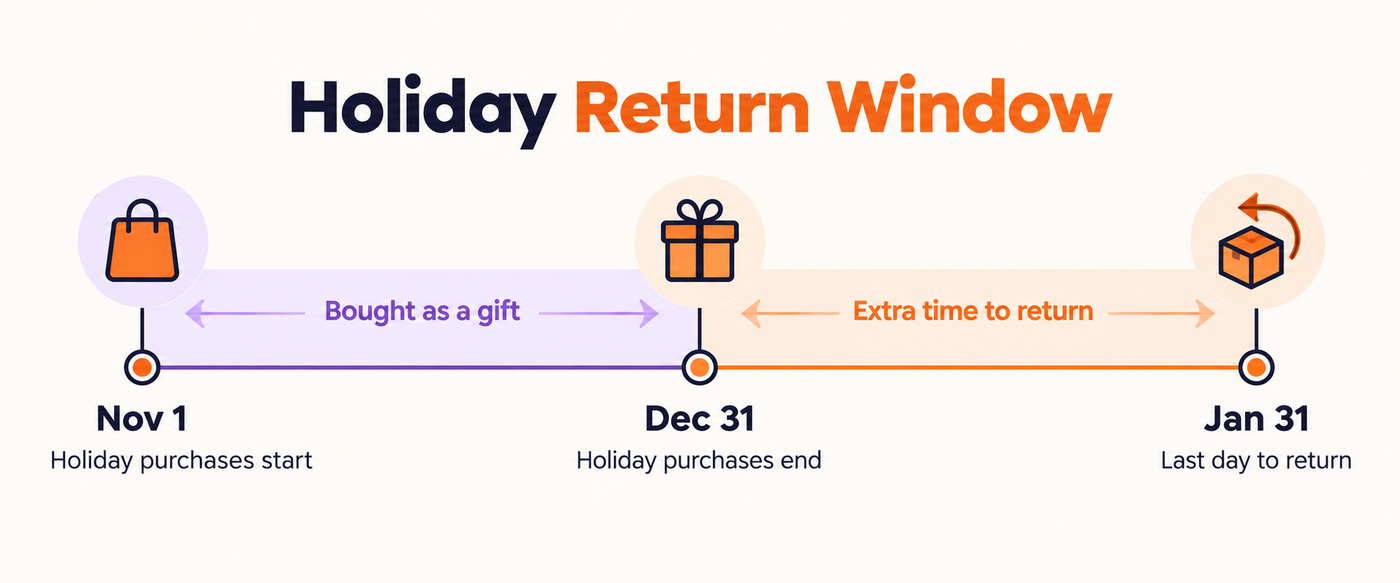
It’s a temporary change to your normal return rules that gives holiday shoppers more time. Usually it works like this: anything bought between a start date (say, November 1) and an end date (say, December 31) can be returned until a set deadline in January.
That’s it. Nothing complicated. The point is to cover the gap between when someone buys a gift and when the person receiving it actually opens the box.
Some brands call it an extended holiday return policy, or a holiday return window. Same idea.
Why Holiday Returns Hit Harder Than Normal Returns
Returns are already a big part of online retail. The National Retail Federation expected US retailers to see a return rate of around 15.8% across 2025. Holiday purchases tend to come back even more often, with some estimates putting holiday returns at 20 to 25% of what gets bought.
And it makes sense. Gifts are guesses. Sizes are wrong, colors are wrong, people get two of the same thing. Unlike a normal purchase, the person returning it often didn’t choose it, doesn’t have the order number, and may not even know which email it was sent to.
On top of that, timing makes everything worse. These returns hit in late December and January, exactly when your team is still catching up on “where’s my order?” tickets from the Christmas rush. If your return process is clunky, this is when it falls over.
What Big Retailers Do (and Why It Matters to You)
Your customers don’t compare your return policy to other small brands. They compare it to Amazon.
Last holiday season, Amazon let most items bought between November 1 and December 31, 2025 be returned until January 31, 2026. Apple products bought there had a shorter deadline of January 15. Most large US retailers run something similar every year.
You don’t have to match that exactly. But if your policy is noticeably stricter, expect more complaints and more “I’ll never buy here again” emails. A good rule of thumb: give at least until mid to late January for anything bought in November and December.
How to Set Up a Holiday Return Policy for Your Shopify Store
1. Pick Your Dates
You need three dates. When eligible purchases start, when they end, and the final return deadline.
A common setup is purchases from November 1 to December 31, returnable until January 31. If you’d rather keep it tighter, November 15 to December 24 with a January 15 deadline works too. When does a holiday return policy start? Whenever you decide, but starting it before Black Friday makes sense, since that’s when a lot of gift shopping begins.
2. Decide What’s Included
Not everything has to be covered. Many stores exclude final sale items, personalized or custom products, opened beauty or hygiene products, and gift cards.
That’s fine. Just say so clearly on the product page and in the policy, not hidden in small print.
3. Make Gift Returns Easy
This is where most small brands fall short. The person returning a gift usually doesn’t have the order number, and they definitely don’t want the buyer to find out they’re returning it.
A few things help a lot. Let people look up an order by the buyer’s email or the gift recipient’s name. Offer gift receipts or a gift note option at checkout. And default gift returns to store credit or an exchange, refunded to the recipient, not back to the original buyer’s card. That way nobody’s surprised.
4. Push Exchanges Over Refunds
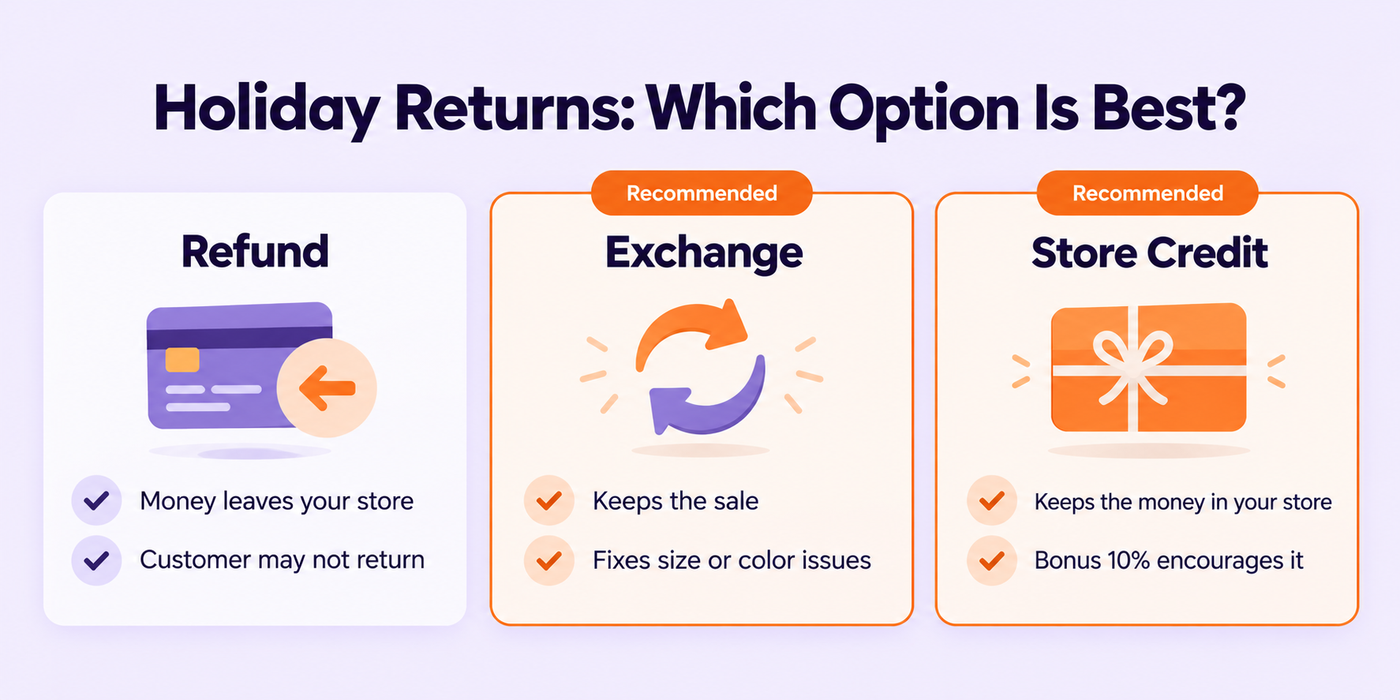
An exchange keeps the money in your store. A refund doesn’t.
Make the exchange option the first and easiest choice in your returns flow. Offer a small bonus for picking store credit instead of cash, like an extra 10%. Plenty of people will take it, especially if the item was a gift and they’d rather pick something themselves.
5. Set Up the Returns Flow in Shopify
Shopify lets you set return rules and windows in your store settings, and customers can request returns through their account. For more control, a lot of brands use a returns app like Loop, Redo or AfterShip Returns. These let you build a self-service returns page, push exchanges, set different windows for different products, and print return labels automatically.
Whichever you use, test it end to end before Black Friday. Request a return as a customer would, on your phone. If it’s confusing for you, it’ll be worse for someone holding a gift they didn’t buy.
6. Write It Down Everywhere
Put the holiday return policy on your returns page, in your footer, on product pages for giftable items, in your order confirmation emails, and in your FAQ and help center. Your support team needs it too, with clear rules for edge cases.
If you’re using macros, add a holiday returns reply. There’s one ready to copy in our post on Black Friday customer service macros.
A Simple Holiday Return Policy Template
Feel free to copy this and change the details.
Holiday Returns
Shopping early for the holidays? We’ve got you covered. Items purchased between [November 1] and [December 31] can be returned or exchanged until [January 31].
Items must be unused and in their original packaging. [Final sale items, personalized products and gift cards] can’t be returned.
Returning a gift? No problem. Start your return at [returns page link] using the order number or the buyer’s email address. Gift returns are refunded as store credit to you, not to the original buyer, so they’ll never know.
Questions? Message us at [email or chat link] and we’ll help you sort it out.
How to Avoid Holiday Return Fraud
A longer window is generous. It also gives dishonest people more room to take advantage. Nothing here needs to be heavy-handed, but a few basics go a long way.
Check returned items before issuing a refund, not after. Look out for “wardrobing,” where someone wears an item to a party and sends it back. Hang tags and security tags on clothing help a lot with this.
Watch for patterns. The same customer returning almost everything, a lot of returns going to one address, or claims of “empty box” on high-value items. Flag those for a closer look.
Be careful with returnless refunds. Letting people keep cheap items instead of paying return shipping can make sense, but set a value limit and don’t offer it to repeat returners.
Get Ready for the January Returns Rush
Most of the work here is operational. A policy only helps if you can actually process the returns that come in.
Plan your staffing for late December through the end of January, not just Black Friday week. Decide who inspects returned items, how fast they go back into stock, and who handles refunds and exchanges. Stock sitting in a corner for three weeks is stock you can’t sell in your January sale.
Track your numbers too. What’s your return rate during the holidays compared to the rest of the year? Which products come back most, and why? If one item gets returned constantly for “runs small,” that’s a fix for your size guide, not just a return to process.
If you’d rather not handle all of this in-house, our returns and refunds management team takes care of return requests, eligibility checks, exchanges and refunds by your rules. For the order side of peak season, see our guide on handling Black Friday order volume on Shopify.

Ecommerce Returns Best Practices (Quick List)
- Show the holiday return deadline clearly before checkout
- Let gift recipients start returns without the buyer
- Make exchanges the easiest option
- Offer a bonus for choosing store credit
- Inspect items before refunding
- Set clear exclusions and stick to them
- Send a confirmation email at every step of the return
- Restock returned items quickly
- Track return reasons and fix the common ones
- Staff your support team through January
Frequently Asked Questions
What is a holiday return policy?
It’s a temporary extension of your normal return window for purchases made during the holiday season. Most stores let items bought in November and December be returned until sometime in January.
When does a holiday return policy usually start?
Many retailers start counting purchases from November 1. Some start later, around Black Friday. The key is to cover the weeks when people are buying gifts.
How long should an extended holiday return window be?
Most stores go until mid or late January. Last season, Amazon gave most holiday purchases until January 31, which is a common benchmark.
Should gift returns get a refund or store credit?
Store credit or an exchange works best for most brands. It keeps the money in your store and avoids refunding the original buyer, who might not want to know the gift came back.
How do I stop return fraud during the holidays?
Inspect items before refunding, use tags on clothing, set clear exclusions, watch for repeat returners, and put a value limit on returnless refunds.
Can I outsource ecommerce returns management?
Yes. Many Shopify brands hand off return requests, checks and refunds to an outside team during busy months. Our ecommerce customer support team can handle returns alongside your other support tickets.
Make Returns Part of the Holiday Plan
A good holiday return policy doesn’t just protect customers. It actually helps you sell, because people buy gifts more easily when they know returns won’t be a hassle.
If you want help setting up your returns process or handling the January rush, take a look at our returns and refunds management service, start with a 15-day free pilot, or just message us on WhatsApp.
Recommended for you

Gorgias vs Zendesk for Shopify: Which Helpdesk Wins in 2026?

Shopify Conversion Rate Optimization for Black Friday: How to Turn More Visitors Into Buyers (2026)

Black Friday Facebook Ads for Shopify: A Meta and Google Ads Plan That Works (2026)