
The Hidden Cost of Ecommerce Returns: How to Protect Your Profit Margins (2026)

Executive Summary
- The true cost of a return goes well beyond the refund. Research from Optoro puts average processing costs at around 30% of an item’s price, and up to 65% for low-value goods.
- To calculate the cost of returns, add return shipping, handling labor, support time, packaging and lost resale value per return, then multiply by your number of returns.
- You can reduce your Shopify return rate with clearer product pages, better size guidance and real customer photos, and track return reasons to fix the biggest causes.
- Make the returns you do get cheaper by pushing exchanges and store credit, processing items quickly and setting smart rules for returnless refunds.
Here’s a little sum we like to walk founders through.
Someone buys an $80 jacket from your store. A week later it comes back. You refund the $80, so on paper you’re back to zero. Except you’re not.
You paid to ship it out, and now you’re paying again to ship it back. Someone on your team opened the box, checked the jacket, steamed it, re-tagged it and put it back on the shelf. Before all that, someone answered two emails about it. The payment processor kept its fee. And the jacket is now last season’s color, so it’ll probably sell at a discount, if it sells at all.
Add it up and that “free” return might have cost you $20 to $30. Multiply that by a few hundred returns a month and you can see why returns quietly wreck margins for so many Shopify brands.
The Real Cost of Returns (It’s Not Just the Refund)
Most brands only look at the refund amount. That’s the bit that shows up clearly in Shopify. The rest is spread across your shipping invoices, your team’s time and your inventory, so it’s easy to miss.
Research from Optoro puts the total cost of processing a return at around 30% of the item’s price on average, and as high as 65% for lower-value goods where you can’t recover much on resale. Forrester has estimated the average cost to process a single online return at about $33 per item.
Those numbers vary a lot by category. But they tell you something important: a return isn’t a neutral event. It’s a cost, and often a big one.
Here’s where the money actually goes.
Shipping, twice. You pay to send the order, and if you offer free returns, you pay to get it back. For bulky items, return shipping alone can cost more than the product’s margin.
Handling and inspection. Someone has to open, check, clean, repackage and restock every return. That’s labor time, and it spikes right when you’re busiest, after the holidays.
Lost resale value. Some items come back damaged, worn or missing tags. Others are fine but have lost value by the time they’re back on the shelf. Seasonal stock is the worst for this.
Support time. Most returns involve at least one or two conversations: how do I return this, where’s my refund, can I swap instead. Each one costs your team a few minutes.
Fees you don’t get back. Depending on your payment provider, processing fees on the original sale often aren’t refunded.
The customer you might lose. A bad return experience can turn a first-time buyer into a one-time buyer. That’s the hardest cost to see, and sometimes the biggest.
How to Calculate the Cost of Ecommerce Returns
You don’t need fancy software for this. A simple spreadsheet is enough. Start with the cost of one average return:
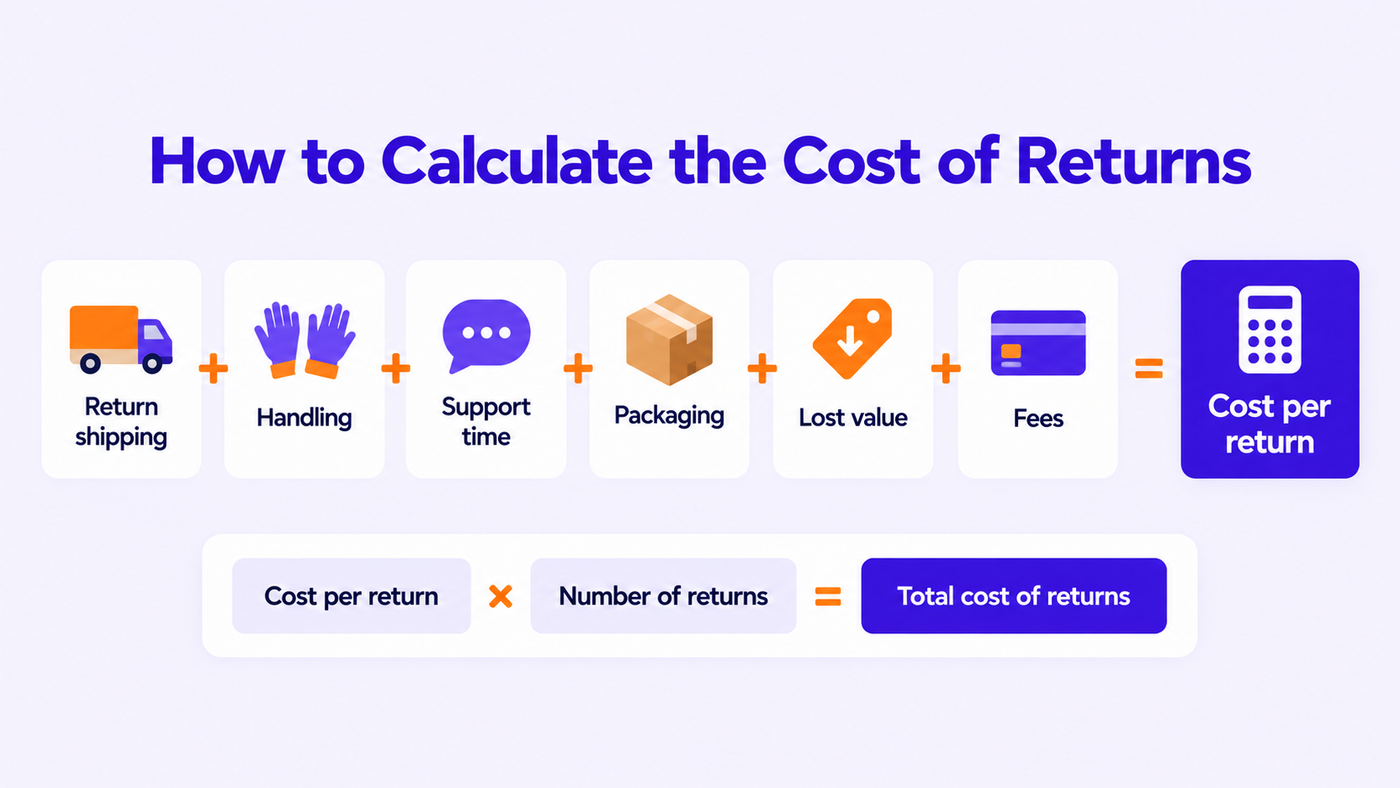
Cost per return = return shipping + handling labor + support time + packaging + lost resale value + fees not refunded
Then work out the total:
Total cost of returns = cost per return × number of returns
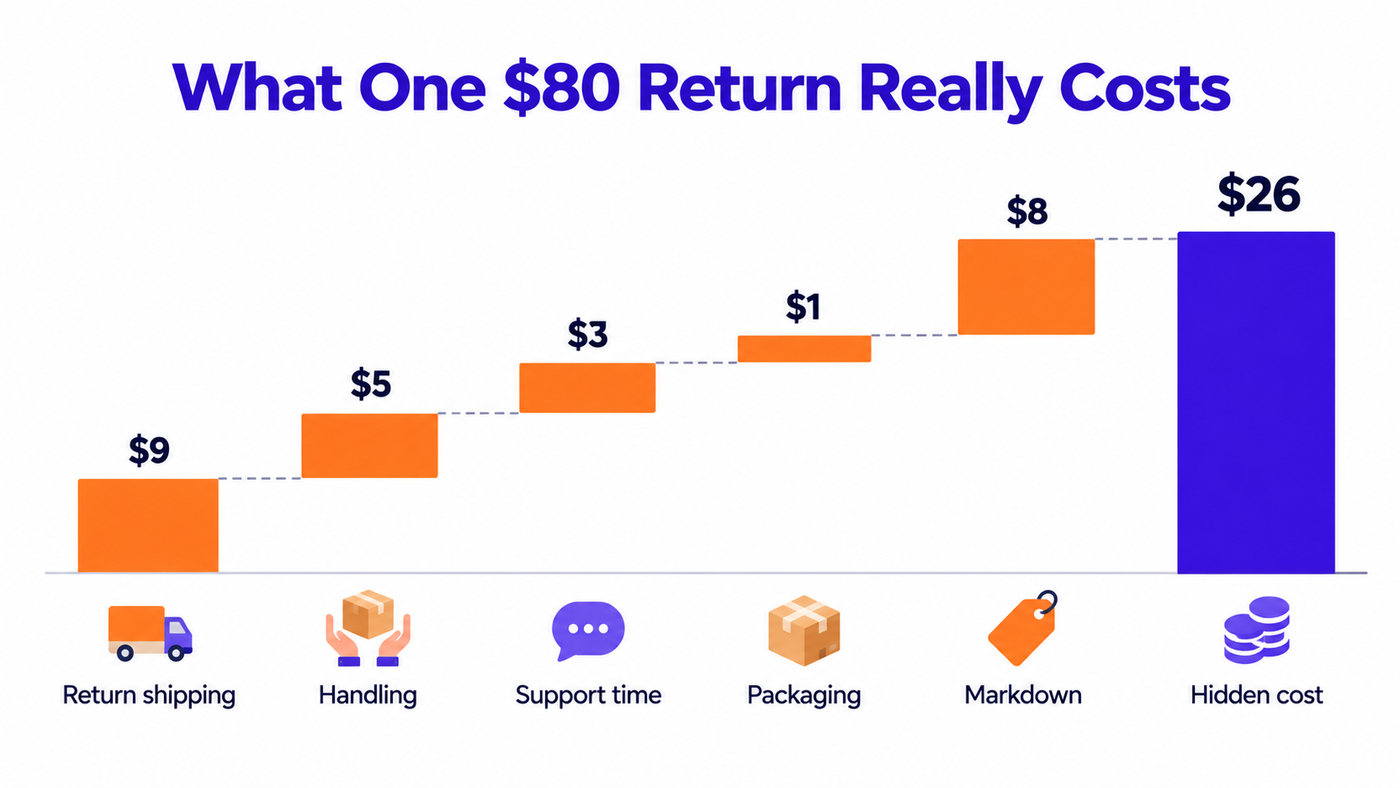
For the $80 jacket, a rough example might look like this: $9 return shipping, $5 for handling, $3 for support time, $1 for new packaging and tags, and $8 in lost value from a markdown. That’s $26, or a little over 30% of the item’s price, before you count the original outbound shipping.
It’s also worth tracking your return rate on its own:
Return rate = (items returned ÷ items sold) × 100
Do this per product, not just for the whole store. Very often, a handful of products cause most of your returns, and that’s where the quick wins are.
What’s the Average Ecommerce Return Rate?
Online returns run much higher than in-store returns. Depending on the source and method, recent estimates for ecommerce return rates land somewhere around 20 to 25%. Apparel and footwear are usually higher, especially when shoppers buy several sizes and keep one. Things like beauty, food and home goods tend to be lower.
Your own number matters more than any benchmark. If your return rate is going up month after month, or one product sits far above the rest, that’s your signal to dig in.
How to Reduce Your Shopify Return Rate
The cheapest return is the one that never happens. And a lot of returns are avoidable, because they come down to the customer getting something different from what they expected.
Make product pages answer the hard questions. Real measurements, a clear size guide, fabric details, and how the item fits on different body types. “Runs small, size up” in plain words near the “Add to cart” button prevents a surprising number of returns.
Show real photos. Studio shots are great, but customer photos and short videos show what the product actually looks like in normal light. They cut down on “not what I expected” returns a lot.
Use reviews that talk about fit. If your review app lets customers rate fit, use it, and show that summary on the product page.
Read your return reasons every month. If you’re not asking why people return things, start now. Most returns portals let customers pick a reason. Then look for patterns. “Too small” on one product means fix the size chart. “Looks different” means fix the photos.
Answer questions before people buy. Live chat on product pages and a clear FAQ help shoppers pick the right size or color the first time. Our guides on ecommerce live chat and building a knowledge base go into how.
Pack it properly. Damaged-in-transit returns are 100% avoidable. Better packaging often costs less than one return.

Ecommerce Returns Best Practices to Protect Your Margins
Some returns will always happen. The goal is to make the ones you get as cheap as possible, without making customers hate you.
Push exchanges and store credit. An exchange keeps the sale. Make it the easiest option in your returns flow, and consider a small bonus for choosing store credit over a refund.
Process returns fast. Every day a returned item sits in a corner, it loses value. Aim to inspect and restock within a couple of days.
Use returnless refunds carefully. For cheap or bulky items, letting customers keep the item can cost less than paying for return shipping. Set a value limit and don’t offer it to repeat returners.
Set clear rules for sale and final-sale items. Say it on the product page, not buried in the policy.
Watch for abuse. Serial returners, worn items and “empty box” claims add up. Flag patterns early.
Get a proper returns portal. Tools like Loop, Redo or AfterShip Returns let customers start returns themselves, push exchanges, print labels and track reasons. Most ecommerce returns management software also gives you the reports you need to see what’s driving costs. Pair it with the self-service ideas in our post on customer service automation.
And if you’re heading into the holidays, set up a proper holiday window ahead of time. Our guide to holiday return policies for Shopify has a template.
Should You Outsource Ecommerce Returns Management?
For a small store, handling returns yourself is usually fine. As volume grows, it becomes a real job: reviewing requests, checking eligibility, answering questions, issuing refunds, coordinating exchanges and keeping on top of return reasons.
That’s where a dedicated team helps. Our ecommerce returns management service at SolutoZeeX handles return requests, eligibility checks, exchanges and refunds by your rules, inside the tools you already use. We also track reasons and costs so you can see where the money’s going, with help from our analytics and reporting team.
Cost of Returns Checklist
- Work out your cost per return using the formula above
- Track return rate per product, not just store-wide
- Collect a return reason for every return
- Fix product pages for the top three return reasons
- Add real customer photos and fit reviews
- Make exchanges and store credit the easiest option
- Inspect and restock returns within a couple of days
- Set a value limit for returnless refunds
- Flag repeat returners and suspicious claims
- Review return costs every month
Frequently Asked Questions
What is the true cost of ecommerce returns?
It’s the refund plus everything around it: return shipping, handling, repackaging, support time, lost resale value and fees. Optoro’s research puts average processing costs at around 30% of an item’s price, and up to 65% for low-value goods.
How do I calculate the cost of returns?
Add up return shipping, handling labor, support time, packaging, lost resale value and fees for an average return. Then multiply that cost per return by the number of returns in a period.
What is the average ecommerce return rate?
Estimates vary by source, but online return rates commonly land around 20 to 25%. Apparel and footwear tend to be higher; beauty and home goods tend to be lower.
How can I reduce my Shopify return rate?
Clear size guides, real measurements, customer photos, fit reviews, good packaging and answering questions before purchase all help. Track return reasons and fix the biggest ones first.
Are exchanges better than refunds?
For most brands, yes. An exchange keeps the revenue and the customer, while a refund loses both. Make exchanges the easiest choice in your returns flow.
What’s the best ecommerce returns management software?
Popular options for Shopify include Loop, Redo and AfterShip Returns. The best one depends on your volume, product type and whether you want features like exchanges, store credit bonuses or returnless refunds.
Stop Returns From Eating Your Margins
Returns are part of selling online. But they don’t have to quietly take a third of every refunded order with them. Know your real cost, fix the causes you can, and make the rest as cheap and painless as possible.
Want a team to manage your returns, or help working out what they’re really costing you? Have a look at our returns and refunds management service, start with a 15-day free pilot, or just message us on WhatsApp.
Recommended for you

Live Chat for Ecommerce: Setup, Staffing and Metrics for Shopify Stores (2026)

Ecommerce Return Solutions: 7 Ways to Cut Return Costs in 2026

Agentic Commerce Optimization for Shopify: How to Get Your Products Chosen by AI Shopping Agents (2026)