
Ecommerce Return Solutions: 7 Ways to Cut Return Costs in 2026

Executive Summary
- Ecommerce return solutions fall into three groups: prevent returns, process them faster, and keep the revenue when a return happens.
- Every return costs more than the refund once shipping, handling and support time are counted.
- The biggest wins for Shopify and D2C brands: clearer product pages, an exchange-first flow, a self-service returns page and a clear policy.
- If returns are swamping your team, outsourcing returns handling is often cheaper than hiring.
Returns are the part of ecommerce nobody plans for. A customer clicks "buy", the parcel ships, and a few days later you get a message: "this doesn't fit, how do I send it back?" Multiply that by a few hundred orders a month and returns stop being an edge case. They become a real line in your profit and loss.
The good news is that most returns are predictable, and most of the cost is avoidable. This guide covers the ecommerce return solutions that actually move the numbers, in the order we would tackle them for a Shopify or D2C brand.
What are ecommerce return solutions?
Ecommerce return solutions are the policies, tools and processes a store uses to handle returns without losing money or customers. That includes your return policy, the page where customers start a return, the apps that create labels and track parcels, the team that checks items and issues refunds, and the steps you take to stop avoidable returns in the first place.
Think of it as three jobs:
- Prevent returns that should never happen (wrong size, wrong expectation, damaged in transit).
- Process the returns that do happen quickly and cheaply.
- Recover the sale through exchanges, store credit and resale.
Why returns cost more than you think
A refund is only the start. Each return also carries return shipping, inspection time, repacking, restocking, and a support conversation. Items that come back late in the season may need to be sold at a discount, or not at all. We break the full picture down in our guide to the hidden cost of ecommerce returns.
Return rates also vary a lot by category. Fashion and footwear are typically the highest because people cannot try items on, while consumables are usually much lower. To know where you stand, measure your own return rate by product, not just the store average. A small number of SKUs usually causes most of the returns.
1. Prevent returns before they start
The cheapest return is the one that never happens. Start by reading your return reasons. Most stores find the same few causes again and again.
- "Does not fit" or "looks different": add a proper size guide, real measurements, model height and size, and customer photos.
- "Not as described": rewrite product descriptions to match reality, including material, colour in different light, and what is in the box.
- "Arrived damaged": fix the packaging for the products that break, and photograph packed orders for high-value items.
Track return reasons weekly. A product with a high return rate for "runs small" is a product page problem, not a returns problem.
2. Write a clear, fair return policy
A vague policy creates support tickets and chargebacks. A clear policy reduces both. Keep it short and put the important points where customers see them: the return window, who pays for shipping, what cannot be returned, and how long refunds take.
Seasonal changes matter too. Many stores extend the window for gifts in November and December. We cover how to set that up in our guide to a holiday return policy for Shopify stores.
3. Make exchanges the easiest option
An exchange keeps the revenue in your store. A refund does not. Put "exchange" first in your returns flow and make it the simplest path. Offer store credit with a small bonus for customers who choose it over a refund.
For scripts and examples you can copy, read our guide to Shopify store credit and exchanges.
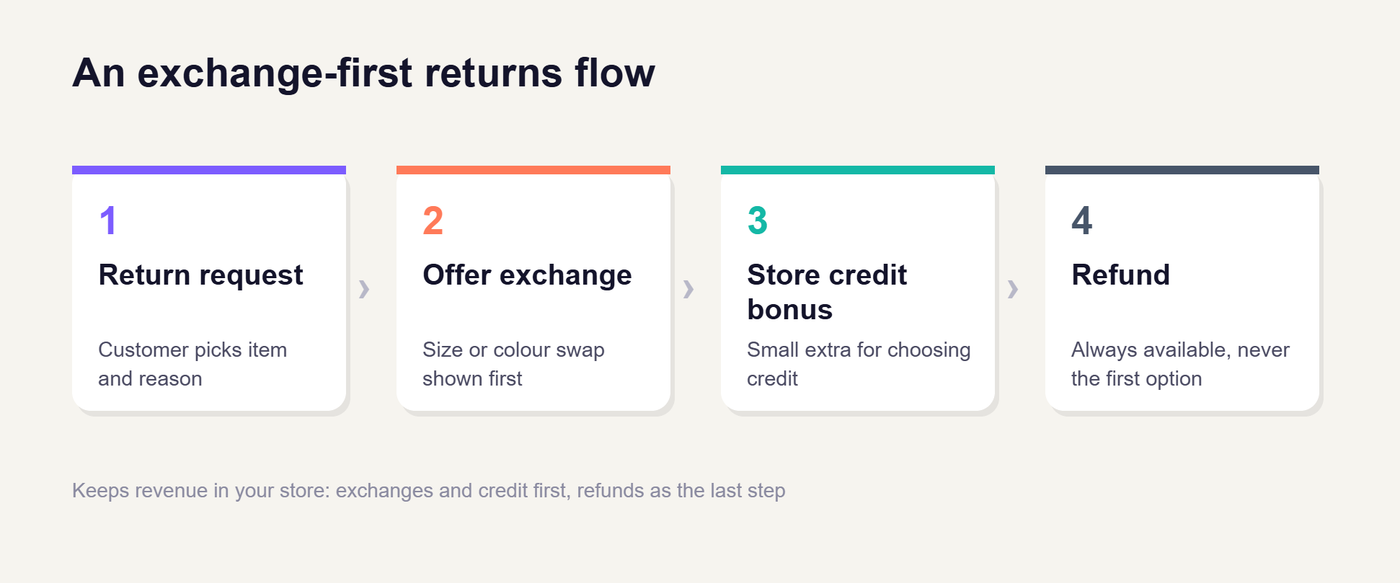
4. Give customers a self-service returns page
If every return starts with an email, you are paying for support time you do not need to spend. A self-service returns portal lets customers enter an order number, pick the item and reason, choose a refund or exchange, and print a label without talking to anyone.
Shopify has basic return handling built in. Dedicated returns apps add things like automated labels, rules per product, exchange flows and return tracking. Pick the simplest tool that covers your needs, and test the full flow on your phone before peak season.
5. Decide on fees, free returns and returnless refunds
Free returns lift conversion but cost margin. A restocking fee protects margin but can put shoppers off. There is no single right answer: it depends on your average order value, margin and return rate. Many brands settle on free exchanges, a small fee for refunds, and returnless refunds only for cheap items. Our breakdown of restocking fees versus free returns walks through the trade-offs.
6. Inspect, restock and resell quickly
Returned stock earns nothing while it sits in a box. Set a simple rule for who inspects returns, how long it takes, and where good items go back into inventory. Items that cannot be sold as new can often go to a clearance collection, a bundle, or a B-grade listing rather than being written off.
7. Watch for return fraud and abuse
Most customers are honest, but a few patterns are worth checking: the same customer returning most of what they buy, "empty box" claims on valuable items, or worn items sent back after an event. Inspect before you refund, use tags on clothing, and set limits for returnless refunds.
When to outsource returns handling
If your team spends hours a day approving returns, checking eligibility, answering "where is my refund?" and issuing refunds, that work can be handed to a trained team who follow your rules. This is common for growing Shopify and D2C brands, especially around peak season. Our returns and refunds management service handles return requests, eligibility checks, exchanges and refunds by your policy, and works alongside our ecommerce customer support team.
Ecommerce Return Solutions Checklist
- Review your top 10 return reasons every month
- Fix size guides and product descriptions for the highest-return products
- Publish a clear policy with the window, fees and exclusions
- Make exchanges the first option
- Offer a self-service returns page
- Set rules for fees and returnless refunds
- Inspect and restock returns within a set number of days
- Watch for repeat-return patterns
Ecommerce Return Solutions FAQs
What are the best ecommerce return solutions for small stores?
Start with a clear policy, an exchange-first flow and a self-service returns page. Those three remove most of the manual work without needing a big budget.
How can I reduce ecommerce returns?
Improve size guides, photos and descriptions, fix packaging for fragile items, and read your return reasons every month to find the products causing the problem.
Should I offer free returns?
It depends on your margin and return rate. Free returns can lift sales but cost more. Free exchanges with a small fee on refunds is a common middle option.
Do I need a returns app on Shopify?
Not always. Shopify handles basic returns. A returns app becomes useful when you want automated labels, different rules per product, or an exchange flow.
Can I outsource returns management?
Yes. Many brands hand return requests, checks and refunds to an outside team, especially during busy periods.
Get returns under control
If returns are taking too much of your team's time, our team can take them over. Start with a free 15-day pilot on your real tickets, or request a free support audit.
Recommended for you

Live Chat for Ecommerce: Setup, Staffing and Metrics for Shopify Stores (2026)

Agentic Commerce Optimization for Shopify: How to Get Your Products Chosen by AI Shopping Agents (2026)

Shopify Store Credit and Exchanges: How to Turn Returns into Repeat Sales (Scripts + Strategies, 2026)