
Agentic Commerce Optimization for Shopify: How to Get Your Products Chosen by AI Shopping Agents (2026)

Executive Summary
- Agentic commerce is when AI assistants research, compare and sometimes buy products for shoppers. Adobe found AI-driven traffic to US retail sites rose 393% year over year in Q1 2026, and it now converts better than other traffic.
- Shopify’s Agentic Storefronts make eligible products discoverable in ChatGPT, and Google’s Universal Commerce Protocol powers checkout in AI Mode and Gemini for eligible US merchants.
- AI agents choose products they can understand: complete product data, clear specs and sizing, accurate stock and prices, and plain-language policies.
- Agentic commerce optimization is mostly good catalog hygiene, structured data, honest reviews and fast, clear support. Start with your top 20 products.
Last month a founder told us something that stuck with us. A customer emailed asking about a jacket, and said, “ChatGPT recommended you.” Nobody on the team had done anything special to make that happen. They’d just written very clear product pages.
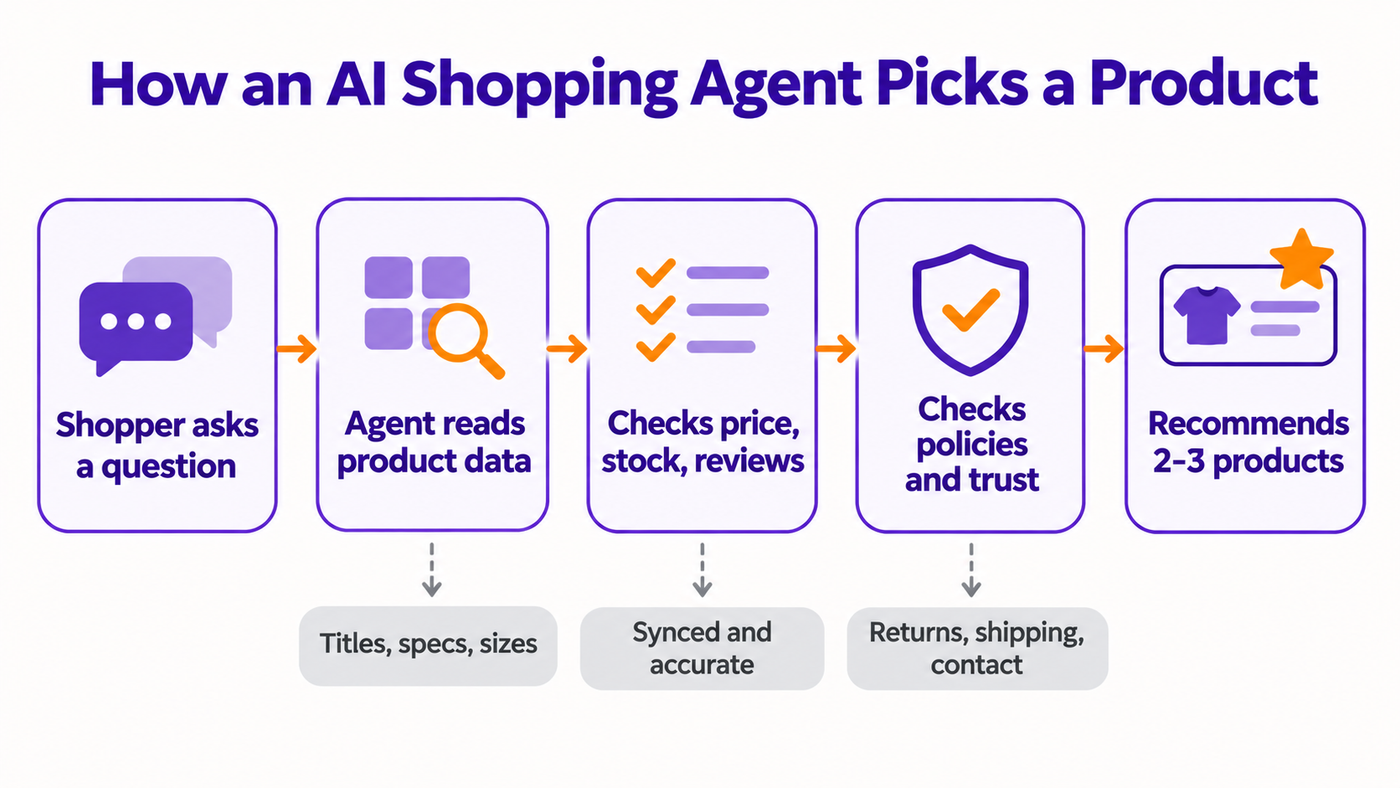
That’s agentic commerce in a nutshell. More and more shoppers aren’t typing keywords into Google and clicking ten tabs. They’re asking an AI assistant, “What’s a good waterproof jacket under $150 that runs true to size?” The assistant reads a bunch of stores, compares them, and suggests two or three. Sometimes it even helps finish the purchase.
If your store is easy for that assistant to understand, you’re in the running. If it isn’t, you’re invisible, however good your products are. Here’s what Shopify brands need to know, and what to actually do about it.
What Is Agentic Commerce?
Agentic commerce is shopping where an AI agent does part of the work for the customer. The agent might search for products, compare options, check reviews and return policies, and, in some cases, place the order.
The “agent” can be ChatGPT, Google’s Gemini and AI Mode, Perplexity, Microsoft Copilot, or a shopping assistant built into an app. The customer still decides. But the agent decides what the customer sees.
That’s the big shift. In regular search, you compete for a click. In agentic commerce, you compete to be one of the few products an AI is willing to recommend.
Why It Matters Right Now
This isn’t a far-off trend anymore. Adobe’s data on US retail sites showed AI-driven traffic up 393% year over year in the first quarter of 2026. And it’s not just more visits. By March 2026, that AI-referred traffic was converting 42% better than other traffic, and visitors spent noticeably longer on site.
There’s a catch in the same research, though. Adobe found that, on average, about a third of product page content wasn’t readable by AI systems. So even stores getting AI traffic are often leaving a lot on the table.
The platforms have moved fast too. Shopify announced Agentic Storefronts in December 2025, which lets eligible products show up inside AI tools like ChatGPT, using the product data you already have in Shopify. Google launched the Universal Commerce Protocol (UCP) in January 2026, built with Shopify, Etsy, Wayfair, Target and Walmart, and it powers checkout in AI Mode and the Gemini app for eligible US merchants.
Agentic Commerce on Shopify: What’s Already Happening
A quick, plain-English rundown, because the details change often.
ChatGPT. Through Shopify’s Agentic Storefronts, eligible products can show up when people shop in ChatGPT. OpenAI has since scaled back its own in-chat “Instant Checkout,” so in most cases the shopper finds your product in ChatGPT and finishes buying on your own Shopify checkout. Orders show up in your Shopify admin like any other channel, and you can manage the channel from your admin settings.
Google AI Mode and Gemini. Google’s UCP lets AI agents talk to stores in a standard way and complete purchases. Merchants set this up mainly through Google Merchant Center, with clear product data, return policies and support details.
Protocols. You’ll hear about the Agentic Commerce Protocol (ACP), which OpenAI developed with Stripe, and Google’s UCP. You don’t need to understand the technical side. For most Shopify brands, Shopify and Google handle the plumbing. Your job is to make sure the information flowing through it is complete and accurate.
Things are still moving quickly, so check your Shopify admin and Merchant Center for what’s available to your store today.
How AI Shopping Agents Decide What to Recommend
Nobody outside these companies knows the exact formula. But from what the platforms publish, and from what we see working, AI agents lean on a few things:
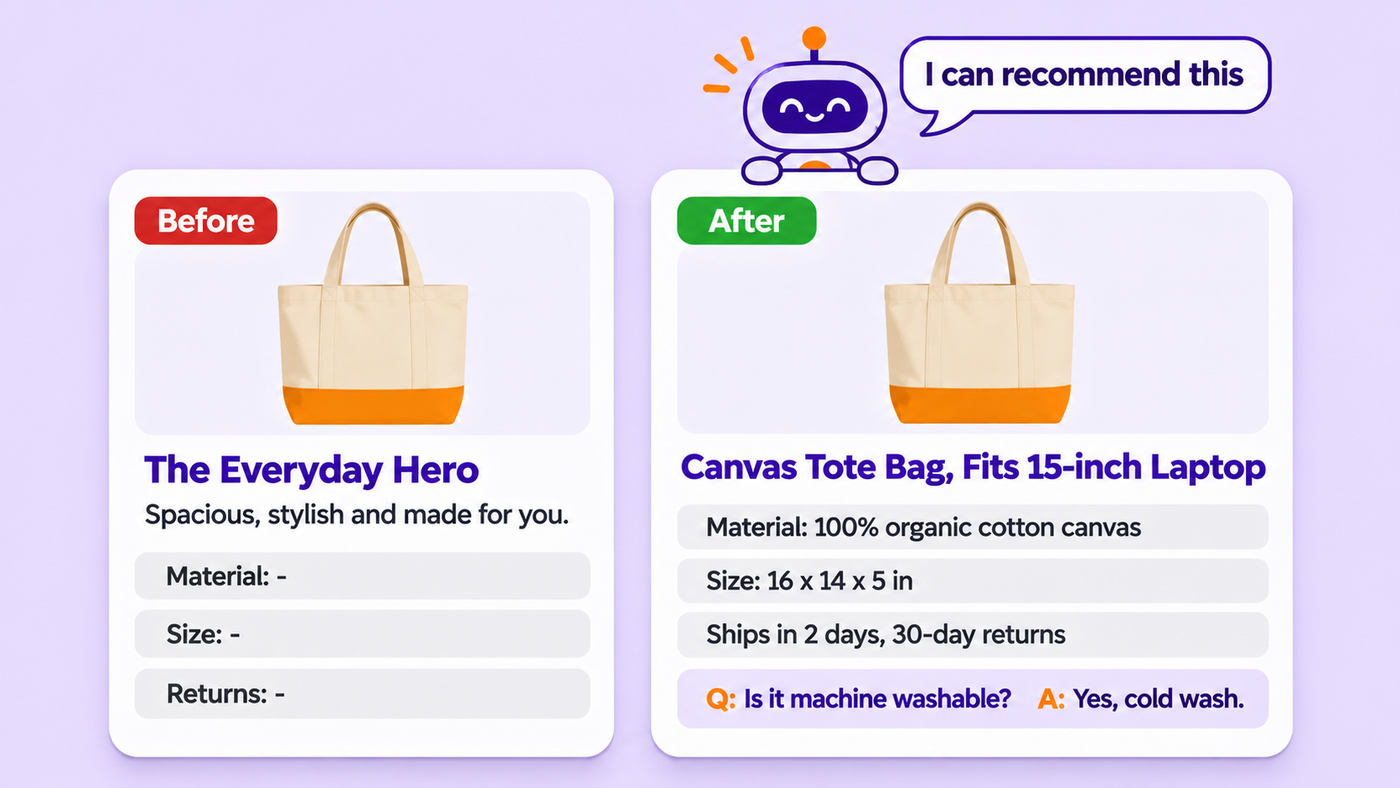
They need to understand the product. Clear titles, real specs, materials, sizes, dimensions, compatibility. “Premium comfort tee” tells an AI nothing. “100% organic cotton crew-neck t-shirt, relaxed fit, runs true to size” tells it a lot.
They need to trust the product and the store. Real reviews, consistent prices across your site and feeds, a clear return policy and visible contact details.
They need to match the shopper’s question. People ask AI very specific things: “for sensitive skin,” “fits a 15-inch laptop,” “arrives before Christmas.” If your page answers those details, you can be matched. If it doesn’t, you can’t.
And they need things to work. Correct stock, correct prices and a checkout that doesn’t break.
Agentic Commerce Optimization: 8 Steps for Shopify Brands
Agentic commerce optimization sounds fancy. In practice, it’s mostly good housekeeping that also helps human shoppers and regular SEO.
1. Rewrite Product Titles for Meaning, Not Mood
Start with your top 20 products. A good title says what the product is, its key attribute and who it’s for. Save the clever brand names for the description.
2. Fill In Every Product Detail
Use Shopify’s product fields and metafields properly: material, size chart, dimensions, weight, color names, care instructions, ingredients, compatibility. Pick standard category settings in Shopify too. Empty fields are invisible to AI. Our product catalog management team does exactly this clean-up for Shopify brands.
3. Answer Real Questions on the Product Page
Look at your support inbox. The questions customers email you, “does it run small?”, “is it machine washable?”, “will it fit an iPhone 16?”, are the same questions people ask AI assistants. Add short answers right on the product page, in a small FAQ block. Our guide to building an ecommerce knowledge base shows how to pull these from your tickets.
4. Make Your Policies Clear and Easy to Find
AI agents check return windows, shipping times and costs before recommending a store. Write them in plain words, keep them consistent everywhere, and link them from product pages. If you need a starting point, our holiday return policy guide has a template.
5. Keep Stock, Prices and Feeds in Sync
If an AI recommends a product and the shopper lands on “sold out” or a different price, that’s a bad experience for everyone, and agents learn which stores are reliable. Keep inventory accurate, and make sure your Shopify data, Google Merchant Center feed and marketplace listings match.
6. Use Structured Data and Clean Pages
Make sure your theme outputs proper product structured data (price, availability, reviews), and that key information is in the page text, not hidden in images or tabs that don’t load. Our ecommerce SEO team checks this as part of a technical audit.
7. Earn and Show Real Reviews
Reviews that mention specifics, fit, quality, delivery speed, help AI agents match your product to detailed questions. Ask happy customers for reviews after delivery, and reply to negative ones calmly. Never fake them.
8. Be Ready for AI-Driven Customers After the Sale
AI agents send customers who arrive with high expectations. If someone bought because ChatGPT said “ships in 2 days,” make sure it does, and make sure your team answers fast when something goes wrong. Proactive order updates and quick support protect the reputation that got you recommended in the first place. Our post on reducing WISMO tickets covers the basics.
Agentic Commerce Examples
A few simple examples of how this plays out:
A shopper asks Gemini for “a vegan leather tote that fits a 14-inch laptop, under $120.” The stores with laptop size, material and price clearly listed get suggested. The ones that just say “spacious everyday bag” don’t.
A shopper asks ChatGPT, “Which of these two serums is better for sensitive skin?” The brand with ingredients, skin-type guidance and reviews mentioning sensitive skin gets the nod.
A shopper asks an AI to find “a gift that arrives before December 24.” Stores with clear shipping cut-off dates are in. Stores without them are skipped.
How to Track AI Traffic
You can start simple. In Google Analytics, look at referral traffic from sources like chatgpt.com, perplexity.ai, gemini.google.com and copilot.microsoft.com. Watch how many sessions, orders and how much revenue they bring each month. Also note that some agent-led orders, especially through protocols like UCP, may not show up as normal page visits, so check orders by sales channel in Shopify too.
Our analytics and reporting team can set up a simple monthly view of AI-driven traffic and sales.
Quick Agentic Commerce Checklist
- Top 20 product titles rewritten to say what the product is
- Every key product field and metafield filled in
- Short FAQ on top product pages, based on real customer questions
- Shipping, returns and contact details clear and consistent
- Stock and prices in sync across Shopify, Google and marketplaces
- Product structured data checked
- Review requests set up after delivery
- AI referral traffic tracked monthly
- Shopify Agentic Storefronts and Google Merchant Center settings reviewed
Frequently Asked Questions
What is agentic commerce?
It’s shopping where an AI agent helps the customer find, compare and sometimes buy products. The agent might be ChatGPT, Gemini, Perplexity, Copilot or a shopping assistant in an app.
What does agentic commerce optimization mean?
It’s the work of making your products easy for AI agents to understand, trust and recommend: complete product data, clear policies, accurate stock and prices, good reviews and structured data.
How does agentic commerce work on Shopify?
Shopify’s Agentic Storefronts make eligible products discoverable in AI tools like ChatGPT using your existing Shopify data. Shoppers usually finish buying on your Shopify checkout, and orders appear in your admin. Check your Shopify admin for which channels are available to your store.
What is the Agentic Commerce Protocol?
The Agentic Commerce Protocol (ACP) is an open standard developed by OpenAI and Stripe that lets AI agents and merchants complete purchases together. Google’s Universal Commerce Protocol (UCP) is a similar standard used for checkout in Google’s AI Mode and Gemini.
What are AI shopping agents?
AI tools that shop on a person’s behalf, by searching products, comparing options and sometimes completing the purchase, based on what the person asks for.
Do I need to change my whole store for agentic commerce?
No. Most of the work is improving the product data and pages you already have. Start with your best-selling products and work outward.
Get Your Store Ready for AI Shoppers
Agentic commerce rewards the brands that are clear, accurate and easy to trust. The good news is that the same work also helps human shoppers and your regular Google rankings.
If you’d like help cleaning up your Shopify catalog, product data and support for AI-driven shoppers, take a look at our product catalog management and Shopify store management services, start with a 15-day free pilot, or just message us on WhatsApp.
Recommended for you

Live Chat for Ecommerce: Setup, Staffing and Metrics for Shopify Stores (2026)

Ecommerce Return Solutions: 7 Ways to Cut Return Costs in 2026

Shopify Store Credit and Exchanges: How to Turn Returns into Repeat Sales (Scripts + Strategies, 2026)