
Customer Support Outsourcing vs In-House for Indian D2C Brands (2026): Costs, Risks and When to Hire an Agency

Executive Summary
- Customer support outsourcing means a specialist agency handles your customer conversations (WhatsApp, email, Instagram, calls) inside your tools, while you keep control of policies and data.
- An in-house team gives you close product knowledge and direct control, but the true cost is much more than salary once you add statutory contributions, tools, hiring, training, attrition, leave cover and festive peaks.
- Outsourcing gives you trained people quickly, longer coverage and easier scaling, but needs a clear handover, good quality checks and strong data protection.
- Many Indian D2C brands do best with a hybrid model: a small in-house lead for escalations and product feedback, plus an agency for volume, WhatsApp and nights, weekends and sale peaks.
Almost every Indian D2C founder starts out as the support team. You’re answering WhatsApp in between calls, replying to Instagram DMs at 1 a.m., and somehow it all works. Then orders pick up, and one fine day you notice you’ve spent half your week typing “your order is on the way, sir.”
That’s usually when the question shows up. Do we hire a couple of support people, or do we hand it to an agency?
We hear this one a lot. And the honest answer is, it depends. On how many orders you’re doing, how fast you’re growing, what you can spend, and how much time you actually have to manage people. So let’s go through both sides properly, including the costs nobody puts in the spreadsheet the first time.
What Is Customer Support Outsourcing?
Think of it like this. The messages still come to your WhatsApp number, your inbox, your Instagram. The difference is that the person typing the reply isn’t on your payroll. They sit with a partner team, log into your tools, and answer the way you’ve told them to.
So no, you’re not giving your brand away. The return policy is still yours. So is the tone, and the call on who gets a refund and who doesn’t. The agency just takes the daily grind off your plate: replying, following up, closing tickets.
When most people hear “outsourcing,” they picture a huge call centre with hundreds of headsets. That’s not really how it works for D2C. More often it’s a handful of people who already get Shopify, COD, RTO and WhatsApp, and who spend their whole day on your account.
The Case for an In-House Support Team
Keeping support in-house has real upsides, and we’d never pretend otherwise.
Your own people sit right next to product, marketing and ops. They hear about the new launch before customers do. If a batch has an issue, they can literally walk over to the warehouse and check. They often care about the brand in a way that comes through in their replies. And you get full say over who’s hired and how they work.
If your product is very technical or very premium, or you only get a handful of tickets a day, one good in-house person might be all you need.
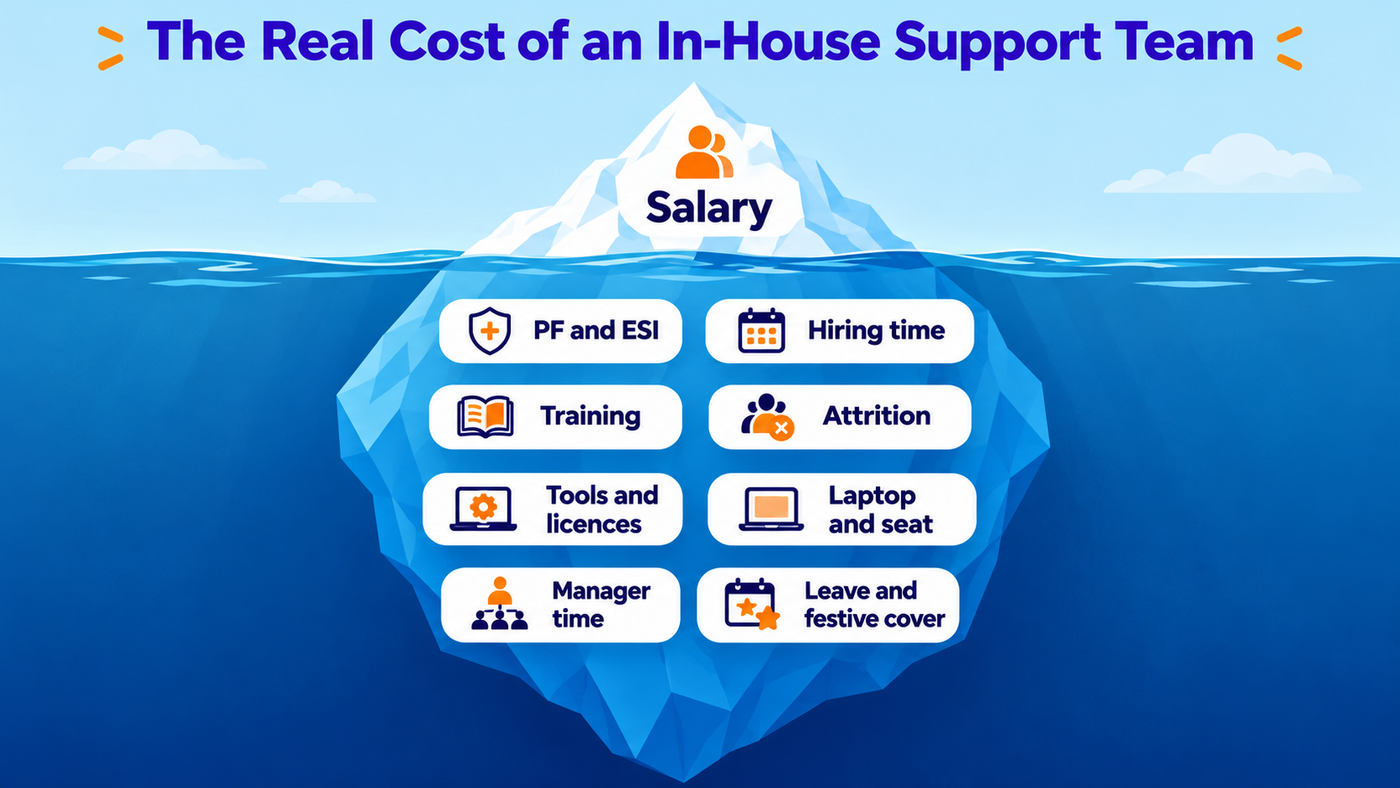
The Real Cost of In-House Customer Support in India
This is the part that catches most founders off guard. Salary is just where the bill starts.
Hire a support executive and you’re typically also paying the employer’s share of PF, plus ESI if the salary is under the limit. Then there’s a laptop, a desk or a work-from-home allowance, licences for your helpdesk and WhatsApp tools, and internet. Somebody has to find the person, which costs time or a recruiter’s fee. Somebody has to train them for a few weeks before they’re properly useful. And somebody, usually you or your ops lead, has to manage them every single day.
Then come the costs you won’t spot on a payslip. Support roles here can see a lot of churn, so you might end up hiring and training for the same seat twice in a year. When someone’s on leave or falls sick, there’s nobody to cover. Want evenings or weekends handled? That means more people or shift allowances. And when Diwali, Big Billion Days or an end-of-season sale doubles your messages for three weeks, your team doesn’t magically double with it.
Here’s a rough example. Say you take on two support executives at around ₹20,000 a month each. Once you add statutory contributions, tools, equipment and a slice of someone’s management time, the real monthly figure can climb well past ₹50,000. That’s before hiring, training or leave cover. And two people still can’t realistically cover seven days a week, late evenings and festive rushes.
Your numbers will look different depending on your city and setup, so do plug in your own. What matters is comparing the full picture, not just the salary line.
The Case for Outsourced Customer Support
Bringing in an agency changes the equation in a few ways.
First, speed. A good partner already has people who know helpdesks, WhatsApp support, COD confirmations and returns, so you can get going in days or a couple of weeks, not months. Second, coverage. Evenings, weekends, even 24/7 support are a lot easier when the agency is handling shifts and backups. Someone’s on leave? Someone else picks it up.
And then there’s scaling, which is honestly the big one for D2C. When a sale doubles your inbox, the agency can add people for a few weeks and pull back once it’s over. You’re not stuck with permanent hires for a temporary spike. Most of the time you pay one predictable monthly amount, instead of juggling salaries, tools, hiring and attrition yourself.
The Risks of Outsourcing (and How to Handle Them)
It’s not all upside, and you’re better off knowing the risks going in.
Tone is usually the first worry, and it’s a fair one. Nobody new is going to sound exactly like your brand on day one. What fixes it is boring but works: a one-page brand guide, ready answers for your common questions, a proper handover chat, and you reading their replies daily for the first few weeks.
Then there’s product knowledge. If your agents don’t really understand what you sell, customers can tell. Send over product sheets, size guides and FAQs, and make it easy for them to ping someone when they’re not sure.
Data is the serious one. Your partner will see names, phone numbers and order details, so get a proper agreement with confidentiality terms, keep their access limited to what they need, and make sure they follow India’s Digital Personal Data Protection Act. We’re not lawyers, so please check the details with yours.
And the sneaky one: when everything’s outsourced, you can slowly lose touch with what customers are actually saying. Ask for a short weekly note on top issues and complaints, and read a few chats yourself every week. It keeps you honest.
In-House vs Outsourcing: Which One Fits Your Brand?
If we had to boil it down, it’d go something like this.
In-house usually makes sense when your ticket volume is low and steady, your product needs deep technical knowledge, and you’ve got someone with the time to hire, train and look after a team.
Outsourcing usually makes more sense when volume is climbing fast, you need WhatsApp, email and social covered every day, you want evenings, weekends or sale peaks handled, or you just don’t have the bandwidth to build and run a support team yourself.
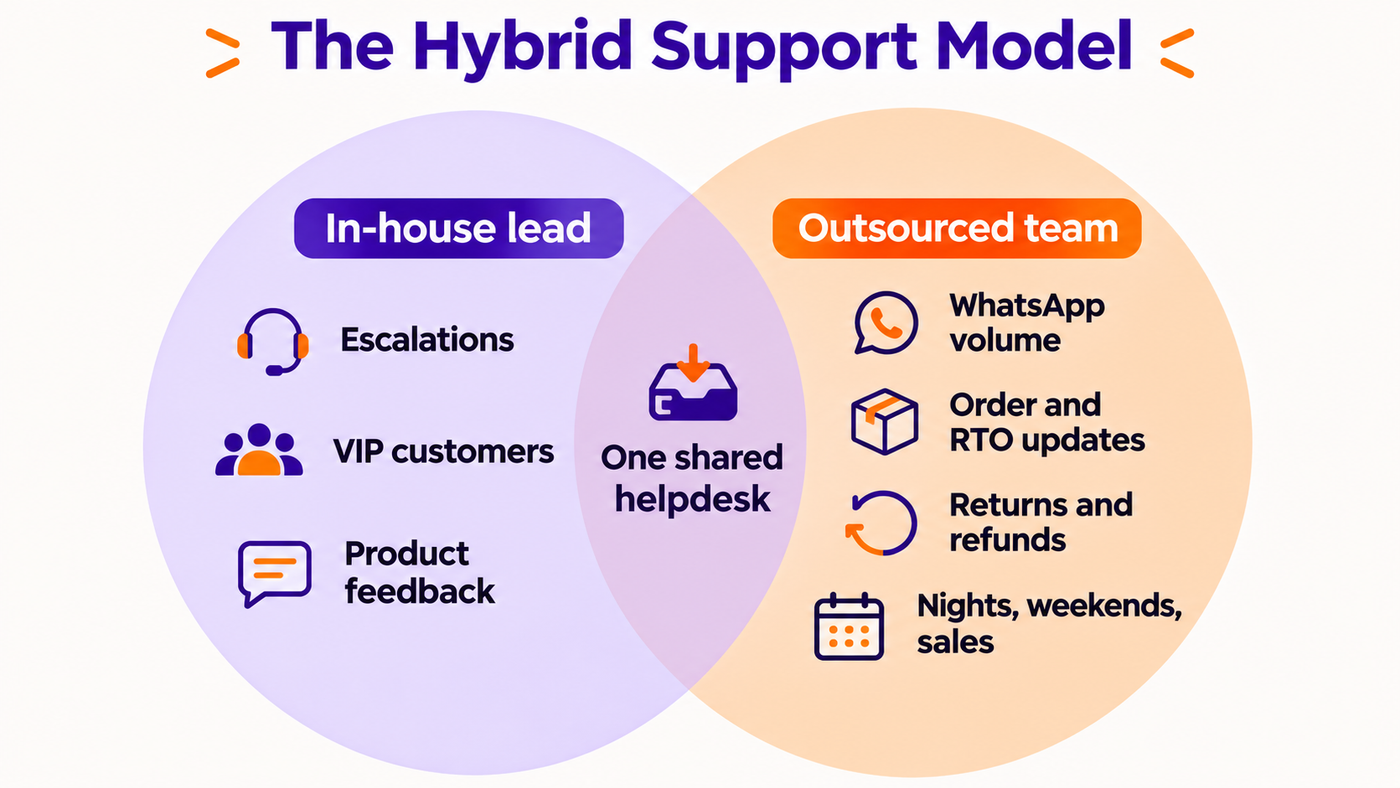
What we see working best for a lot of Indian D2C brands, though, is a mix. One in-house person owns escalations, VIP customers and product feedback, while an agency takes care of the daily volume, WhatsApp, nights, weekends and sale rushes. Everyone works out of the same helpdesk, so nothing slips through the gap between teams.
Signs It’s Time to Hire an Agency
You’ll usually know. WhatsApp messages start sitting unanswered for hours, sometimes overnight. You, or someone from marketing, are still replying to support every day. Response times fall apart every time there’s a sale. Maybe you’ve hired support staff before and they moved on within the year. You’d love weekend or evening support but can’t staff it. RTO, refund requests and complaints are creeping up and nobody has time to follow up properly. Or there’s a big sale or launch coming and you already know the team won’t keep up.
If two or three of those sound uncomfortably familiar, it’s worth having a proper look at customer support outsourcing.
How to Choose a Customer Support Outsourcing Company in India
Not every agency suits a D2C brand, so here’s what we’d poke at before signing.
Ask who else they’ve worked for. You want people who’ve handled Shopify or WooCommerce stores, dealt with Shiprocket or Delhivery, and lived through COD-heavy months. Supporting an online brand is a completely different game from answering calls for a telecom company or a bank.
Find out how they handle WhatsApp, because that’s where most of your customers will message. Check which languages they can reply in, Hindi and whatever else your buyers speak, not just English. The ones worth working with will happily log into your helpdesk and your WhatsApp setup, so the data stays with you and you can see every single chat.
Get response times, resolution times and quality scores agreed before you start, plus a weekly report. And if they offer a short pilot, take it. Two weeks of real tickets will tell you more than ten sales calls.
If you sell abroad as well, our guide to choosing an outsourcing partner covers what to look for with US and UK customers.

How to Make the Switch Smoothly
If you do go the agency route, the first few weeks are where it either clicks or doesn’t.
Get your policies on paper before anything else. Shipping, returns, refunds, exchanges, COD, cancellations, and when something needs to come to you. Then make a list of the twenty questions customers ask you most, with the answers you’d actually give. Hand over access to your helpdesk, WhatsApp and order panel, but only what they need. Spend an hour on a proper handover call and let them ask the silly questions too. For the first few days, have them shadow how your team replies before they go live.
After that, read what they’re sending. Every day for the first two weeks, then once a week when you’re happy. It sounds like a lot, but it’s far less work than training a new hire from scratch.
One thing that makes all of this easier is having tags and saved replies set up beforehand. Our post on customer service automation walks through it, and if a sale’s around the corner, the festive sale customer support checklist is a good one to keep handy.
Frequently Asked Questions
What is customer support outsourcing?
You hand your customer chats, emails, DMs and sometimes calls to an outside team. They reply using your rules and your tools, so customers just see your brand.
How much does customer support outsourcing cost in India?
Honestly, it varies a lot. Some agencies charge per agent per month, some per ticket, some per hour, and channels, hours and languages all change the price. The fair comparison is against what an in-house team really costs you once PF, tools, hiring, training, churn and leave are added in.
Is in-house or outsourced customer support better?
Neither wins every time. If you get a few tickets a day and sell something very technical, in-house can be fine. If you’re growing fast, live on WhatsApp and dread every sale, an agency usually makes life easier. A lot of brands end up doing both.
Is customer support the same as BPO?
Not really. BPO is a huge umbrella that covers everything from payroll to data entry. Support outsourcing for a D2C brand is usually a small, focused team that only deals with orders, deliveries, returns and refunds.
How do I choose a customer support outsourcing company in India?
Ask about their ecommerce clients, how they handle WhatsApp, which languages they reply in and whether they’ll work inside your helpdesk. Get response times and reporting agreed in writing, check how they protect customer data, and start with a short trial before signing anything long.
Can an agency provide 24/7 customer support?
Most can, and for a lot of brands that’s the whole reason to outsource. Covering nights and weekends with your own staff usually means hiring extra people or paying shift allowances.
Make the Choice That Fits Your Growth
There’s no one right answer here. In-house gives you closeness and control. Outsourcing gives you speed, coverage and room to flex. A mix of the two often gives you the best of both. What matters most is comparing the real costs, being honest about how much time you’ve got to manage people, and picking a setup that keeps your customers happy as you grow.
Curious how outsourced support would look for your brand? Have a look at our outsourced customer support and WhatsApp Business support services, start with a 15-day free pilot, or just message us on WhatsApp.
Recommended for you
Live Chat for Ecommerce: Setup, Staffing and Metrics for Shopify Stores (2026)

Ecommerce Return Solutions: 7 Ways to Cut Return Costs in 2026
Agentic Commerce Optimization for Shopify: How to Get Your Products Chosen by AI Shopping Agents (2026)