
Restocking Fee vs Free Returns: What D2C Shoppers Expect in 2026 (and What Shopify Brands Should Do)

Executive Summary
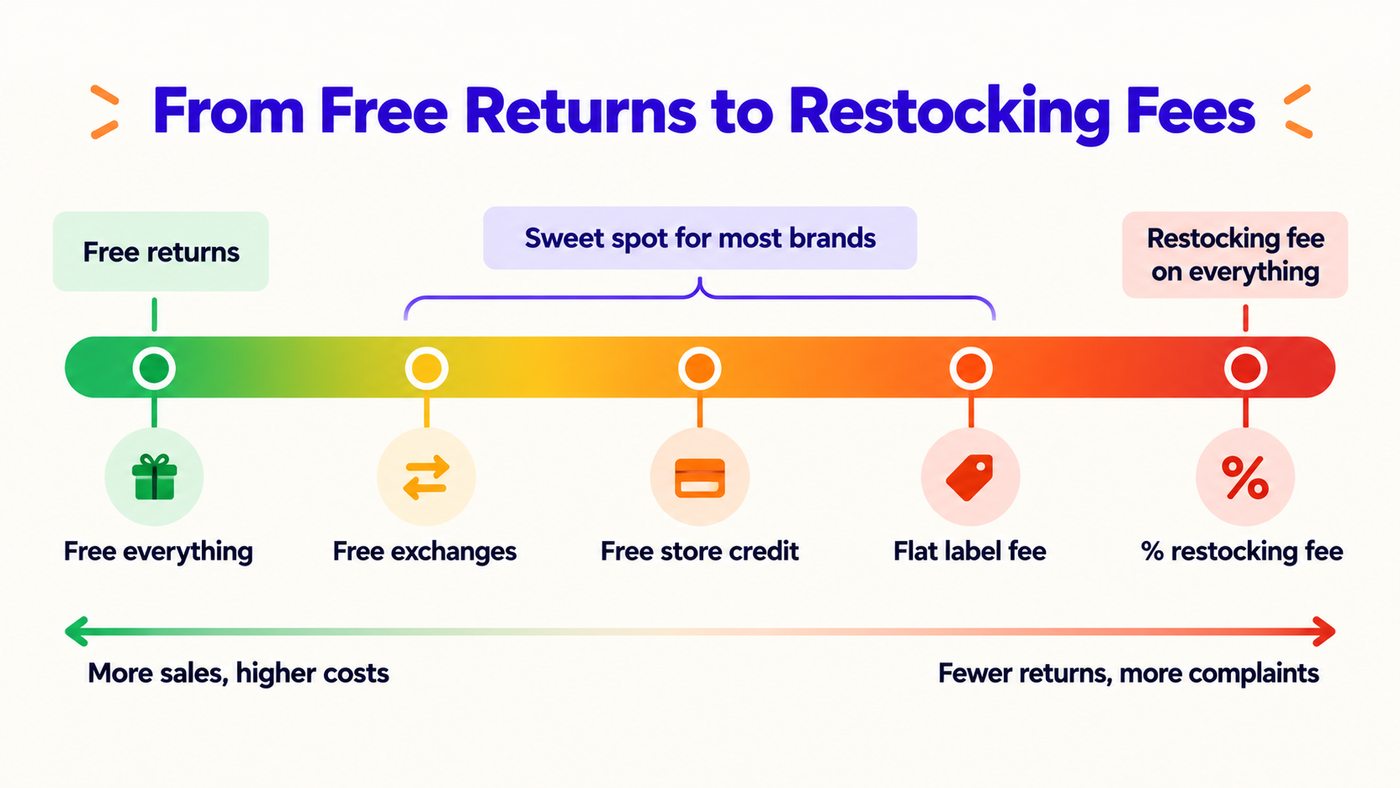
- A restocking fee is a charge deducted from a refund to cover the cost of handling a return. Many retailers that charge one land somewhere around 10% to 25% of the item price, often 15%.
- Shoppers still care a lot about free returns. In the NRF and Happy Returns 2025 report, 82% said free returns are an important consideration when shopping online.
- At the same time, 72% of large retailers now charge for at least some returns. Those that started charging saw fewer returns, but also more complaints and some lost customers.
- For most Shopify brands, the best answer is a middle ground: free exchanges or store credit, small fees only where returns are truly costly, and a policy that’s crystal clear before checkout.
A founder asked us last week, half joking, “If I add a restocking fee, will my returns go down or will my sales go down?”
Honestly? Probably both, a little. And that’s exactly why this decision is so tricky.
Free returns have become something shoppers just expect. But returns are expensive, and in 2026 more and more brands are quietly adding fees to cover the cost. So where should a Shopify brand land? Let’s look at what restocking fees actually are, what shoppers expect right now, and the options that tend to work best.
What Is a Restocking Fee?
A restocking fee is an amount taken off a customer’s refund when they return something. It’s meant to cover the cost of handling that return: checking the item, repackaging it, putting it back in stock, or sometimes selling it at a discount because it’s been opened.
It’s usually a percentage of the item price. Many retailers that charge one set it somewhere around 10% to 25%, with 15% being a pretty common choice. Some use a flat fee instead.
Electronics, furniture, appliances, special orders and anything that’s hard to resell once opened are where you see restocking fees most often. In fashion and beauty, they’re much less common, because shoppers there are used to easy returns.
Restocking Fee vs Return Shipping Fee vs Free Returns
These three get mixed up a lot, so here’s the quick version.
A restocking fee covers the cost of handling and restocking the item. It’s usually a percentage, deducted from the refund.
A return shipping fee covers the cost of getting the parcel back to you. It’s often a flat amount, like the price of a prepaid return label, deducted from the refund or charged upfront.
Free returns means the customer pays nothing: no shipping, no restocking. You cover all the costs.
Some brands charge one, some charge both, and plenty charge neither. Many use different rules for refunds versus exchanges, which we’ll get to.
What Shoppers Actually Expect in 2026
Shoppers haven’t stopped caring about free returns. If anything, they care more.
In the 2025 Retail Returns Landscape report from the NRF and Happy Returns, 82% of shoppers said free returns are an important consideration when shopping online, up from 76% the year before. About three in four said they’d rather choose a return option that gives them an instant refund or exchange. And 71% said a poor returns experience makes them less likely to shop with that retailer again.
People read your policy before they buy, too. If they see a fee they didn’t expect, some will simply leave and buy from someone else.
Why More Brands Are Charging for Returns Anyway
So why are fees spreading? Because returns cost real money.
The same NRF report found that 72% of large retailers now charge for at least some returns, up from 66% the year before. The top reasons they gave were rising operating costs for processing returns and higher carrier shipping costs, both cited by 40%, followed by economic uncertainty and tariffs.
And it does reduce returns. Retailers that started charging commonly reported fewer returns overall. But there’s a catch. According to eMarketer’s summary of the same research, 47% of merchants that began charging saw more customer complaints, 37% said they lost customers because of the fees, and around a third saw their average order value drop.
Worth noting: those numbers come from large retailers. For a smaller D2C brand still building trust, the downside of a fee can hit harder.
If you want to see what returns are really costing you before deciding, our guide to the hidden cost of ecommerce returns walks through the math.
Should You Charge a Restocking Fee on Shopify?
There’s no one right answer, but here’s how we think about it with our clients.
A restocking fee can make sense if your products are expensive to process or hard to resell once opened, like electronics, furniture, custom or personalized items. It can also make sense for very bulky items where return shipping eats most of the margin, for wholesale or B2B orders, or if you’re seeing a lot of “bracketing,” where shoppers buy several sizes on purpose and send most of them back.
It usually doesn’t make sense if you’re a fashion or beauty brand selling mostly to first-time buyers, if your average order value is low, or if your competitors all offer free returns. In those cases, a fee can easily cost you more in lost sales than it saves on returns.
A good test: look at your return reasons. If most returns are “didn’t fit” or “looked different,” fix those causes first. Charging customers for problems your product pages created rarely goes down well.
What Is a Reasonable Restocking Fee?
If you do charge one, keep it proportional. For most D2C products, a fee somewhere between 10% and 15% feels reasonable to shoppers. Going above 20% starts to feel like a penalty, unless the item really can’t be resold at full price.
The fee should roughly match what the return actually costs you. If handling a return costs you $8 and you charge 25% on a $200 item, that’s $50, and customers will notice.
How to Calculate a Restocking Fee
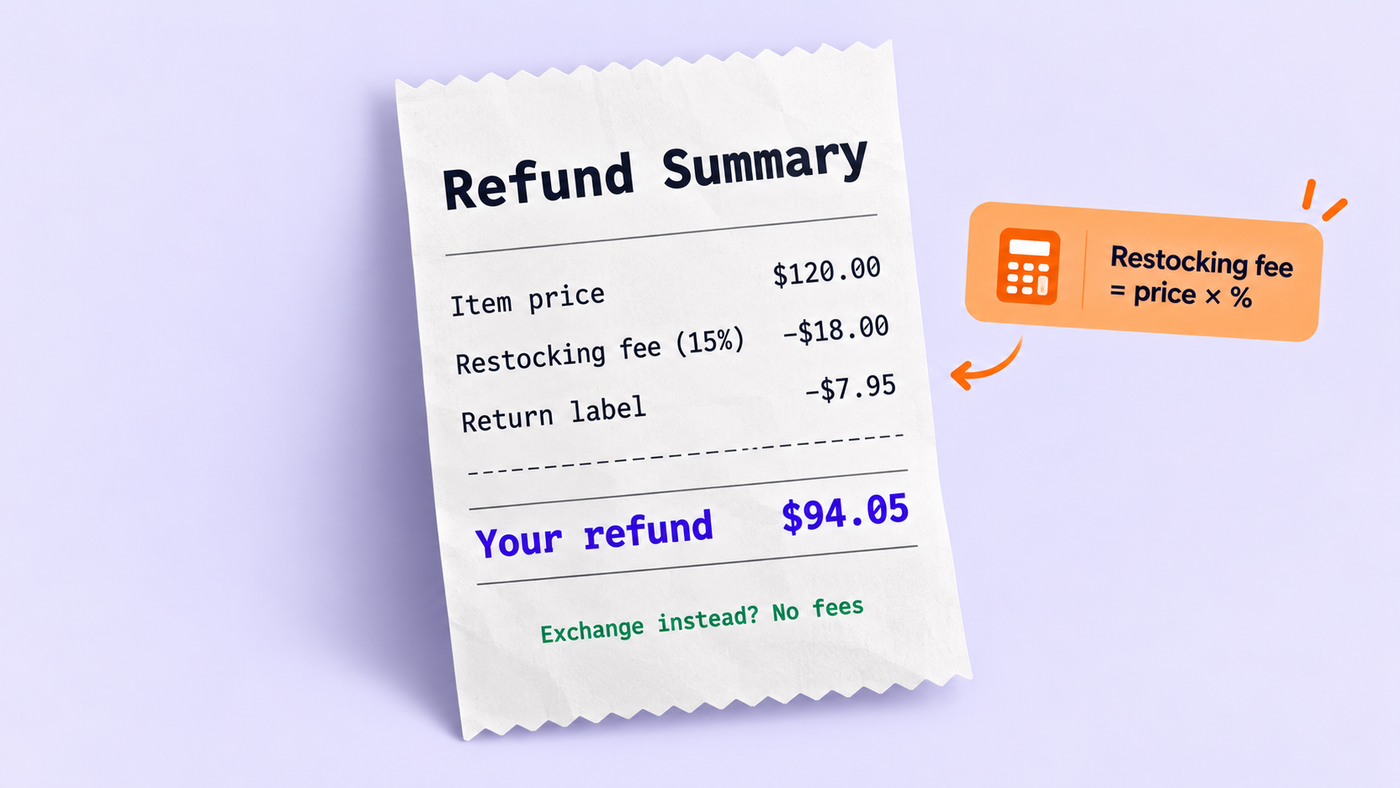
The basic formula is simple:
Restocking fee = item price × restocking fee percentage
So a 15% restocking fee on a $120 item is $18. If you also charge a return shipping fee, say $7.95 for a prepaid label, the customer’s refund would be:
$120 − $18 − $7.95 = $94.05
Always show customers this breakdown before they confirm the return. Surprises at refund time turn into angry tickets and chargebacks.
Middle-Ground Options That Work Better for Most Brands
Before choosing between “free everything” and “fees on everything,” consider these. In our experience, they keep shoppers happy and still protect your margins.
Free exchanges, paid refunds. Exchanges keep the sale, so make them free. Charge a small fee only when someone wants their money back. This alone nudges a lot of people toward exchanges.
Free store credit, paid refunds. Similar idea. Give store credit with no fee, and maybe even a small bonus.
Free returns within a short window. Free for the first 14 days, a small fee after that, for example.
Free returns for loyal customers. Free for members or repeat buyers, a small fee for everyone else.
A flat return label fee instead of a percentage. A small, flat charge for the prepaid label feels fairer than a percentage to most shoppers.
Fees only for opened or used items. No fee if it comes back unopened with tags, a fee if it’s been opened, worn or used.
Let customers keep cheap items. For low-value or bulky products, refunding without asking for the item back can cost less than paying for return shipping.
Most returns apps for Shopify, like Loop, Redo and AfterShip Returns, let you set up rules like these. Shopify’s own returns flow also lets you deduct a restocking fee and return shipping when you process a refund.
Are Restocking Fees Legal?
In the US, restocking fees are generally allowed, as long as you’re clear about them. The key is disclosure. Customers should be able to see the fee before they buy, in your return policy and ideally on the product page or at checkout. Some states have specific rules about how return policies must be shown, and rules differ in the UK, Canada and Australia, where consumer protection laws are stricter.
This isn’t legal advice, so check with a lawyer for your specific situation and the regions you sell to.
Restocking Fee Policy Template
Here’s a short template you can adapt for your returns page. Adjust the numbers to suit your products.
Returns and restocking fee
We want you to love your order. If something isn’t right, you can return it within 30 days of delivery.
- Exchanges and store credit are always free.
- Refunds to your original payment method have a 15% restocking fee, deducted from your refund.
- Return shipping is free for exchanges. For refunds, a $7.95 return label fee is deducted from your refund.
- Items must be unused, with original tags and packaging. Opened or used items may not be eligible.
- Final sale and personalized items can’t be returned.
Questions? Contact us at [support email] or chat with us anytime.
How to Talk About Fees Without Losing Customers
The way you explain a fee matters as much as the fee itself.
Be upfront. Mention it on product pages and at checkout, not only in the footer. Explain why: “This helps us keep prices low and cover handling costs.” Always offer the free option alongside the paid one: “Exchange for free, or refund with a 15% fee.” And make sure your support team has a friendly saved reply ready for “Why was I charged a restocking fee?” Our customer service macros post has templates you can adapt.
If you’re planning holiday changes too, our guide to holiday return policies on Shopify covers extended gift windows and timing.
Frequently Asked Questions
What is a restocking fee?
It’s an amount deducted from a refund to cover the cost of processing a returned item, like inspecting, repackaging and restocking it. It’s usually a percentage of the item price.
How much is a normal restocking fee?
Many retailers that charge one land somewhere around 10% to 25% of the item price, with 15% being common. For most D2C brands, 10% to 15% is easier for shoppers to accept.
Are restocking fees legal?
In the US, they’re generally allowed if they’re clearly disclosed before purchase. Rules vary by state and country, so check with a legal advisor for your situation.
Should I charge a restocking fee on Shopify?
It depends on your products and customers. It can make sense for electronics, furniture, custom or bulky items. For fashion and beauty brands selling to first-time buyers, free exchanges with a small fee only on refunds usually works better.
Do I have to pay for return shipping?
That depends on the store’s policy. Some offer free return shipping, others deduct a flat label fee from the refund, and some only offer free returns for exchanges or store credit.
What’s the difference between a restocking fee and a return shipping fee?
A restocking fee covers handling and restocking the item. A return shipping fee covers the cost of sending it back. Some stores charge one, both or neither.
Do shoppers still expect free returns?
Yes. In the NRF and Happy Returns 2025 report, 82% of shoppers said free returns are an important consideration when shopping online.
Find the Balance That Works for Your Brand
There’s no perfect policy. Free returns help you sell, fees help you protect margins, and the right answer is usually somewhere in between. Know your real return costs, fix the reasons people return things, and keep whatever policy you choose simple and clear.
If you’d like help designing a return policy, setting up returns rules in Shopify, or handling returns and refund questions for you, take a look at our ecommerce returns and refunds management service, start with a 15-day free pilot, or just message us on WhatsApp.
Recommended for you

Live Chat for Ecommerce: Setup, Staffing and Metrics for Shopify Stores (2026)

Ecommerce Return Solutions: 7 Ways to Cut Return Costs in 2026
Agentic Commerce Optimization for Shopify: How to Get Your Products Chosen by AI Shopping Agents (2026)